Driver Recruiting's Blind Spot: Why New Truck Drivers Quit in the First 30 Days
By DriverOpenDoor Insights
TL;DR
Driver recruiting costs $5,000 to $12,000 per hire, then goes dark for the 30 days when most new hires decide to stay or quit. One to two of every 10 new drivers leave before day 30, at $8,000 to $14,000 each. The DriverOpenDoor recruiter portal gives recruiters a live vesting clock and early warnings for the drivers they placed, free for up to 5 active drivers, and included in every fleet plan.
Filling one driver seat costs somewhere between $5,000 and $12,000. Recruiting, onboarding, orientation, the weeks of reduced productivity while the driver ramps up. If an agency placed them, add 15 to 25 percent of first year pay, which works out to $9,000 to $16,000 per placement. While the seat sits empty, the truck loses $250 to $1,500 a day in revenue.
You track all of it. Cost per fill, agency invoices, time to hire, ad spend, cost per lead.
Then the driver starts work. And for the next 30 days, the most expensive and most fragile stretch of the whole equation, the tracking stops.
That is the blind spot, and it is where the money leaks.
What is driver recruiting's 30-day blind spot?
The 30-day blind spot in driver recruiting is the stretch after a new hire starts work: recruiting spend has stopped being measured, but the hire is statistically most likely to quit.
You spent five figures acquiring the driver. Every metric you watched, cost per application, cost per interview, cost per hire, retired the moment the driver signed. From day one to day thirty, the hire sits in the one window where trucking loses the most drivers, and there is no instrument pointed at it.
For a fleet that hires 10 drivers a month, here is what leaks through that gap:
- One to two of every 10 new hires gone before day 30
- $8,000 to $14,000 to replace each one
- $100,000 to $280,000 a year booked as "turnover" when most of it was fixable
This is the same money, just wearing a different label. The recruiting budget and the turnover budget are one budget. The blind spot is what connects them.
How much does it cost to recruit a truck driver?
Industry benchmarks put the cost of recruiting and onboarding a single truck driver between $5,000 and $12,000. A frequently cited study from the Upper Great Plains Transportation Institute at North Dakota State University measured it at $8,234 back in 2019, and inflation plus a tighter labor market has pushed current estimates toward the top of the range.
The full stack for one hire:
- Job board and ad spend: $2,000 to $5,000 per successful hire
- Agency placement fees: 15 to 25 percent of first year pay, roughly $9,000 to $16,000
- In-house recruiter compensation: $45,000 to $80,000 salary plus per-hire placement bonuses
- Onboarding, orientation, and weeks of reduced productivity while the driver ramps
- Empty truck revenue loss while the seat is open: $250 to $1,500 per day
We break down the full replacement cost, including the hidden line items nobody counts, in What Does It Cost to Replace a Truck Driver?
Why do new truck drivers quit in the first 30 days?
Most drivers who quit a new fleet decide within their first month. And the reasons are rarely dramatic.
A dispatcher who takes three days to answer a question. A truck with a recurring issue that maintenance keeps "fixing." A promise about home time from the interview that quietly disappears. A pay stub that does not match what was said on the phone.
The driver does not raise it. They are new, they do not know who to trust, and they do not want to be "that guy" in week two. So they say nothing to management, mention it to nobody, and update their resume.
You find out on day 24, when the resignation lands. Then you refill the seat and pay the whole bill again.
This is the same dynamic that makes traditional surveys fail with drivers, which we cover in Why Truck Drivers Ignore Your Surveys. New hires especially will not attach their name to a complaint about the person who controls their loads. The problems only surface honestly when the feedback is anonymous.
The people already positioned to catch it
Here is the part most fleets miss: you already employ the fix.
Your recruiters placed those drivers. They have the relationship, the phone number, and the trust. Most good recruiters do informal check-in calls anyway, because they know the first month decides whether their hire sticks.
The problem was they had nothing to check in against. No signal, no clock, no warning. Just a driver who stops answering, and a placement bonus that never vests.
So we built them that.
How does the DriverOpenDoor recruiter portal work?
The DriverOpenDoor recruiter portal gives in-house and third-party recruiters a live view of the drivers they personally placed, powered by the same anonymous weekly SMS check-ins the fleet platform already uses.
It works in three steps:
- The recruiter claims their driver: name, mobile number, hire date. Takes about 30 seconds.
- The driver gets an anonymous weekly check-in text. 60 seconds to answer, from the cab, no app, no login. The driver can opt out any time by replying STOP.
- The recruiter watches a live vesting clock for each hire, sees how the driver is feeling each week, and gets an early warning the moment one starts wobbling.
Here is what a hire looks like inside the portal:
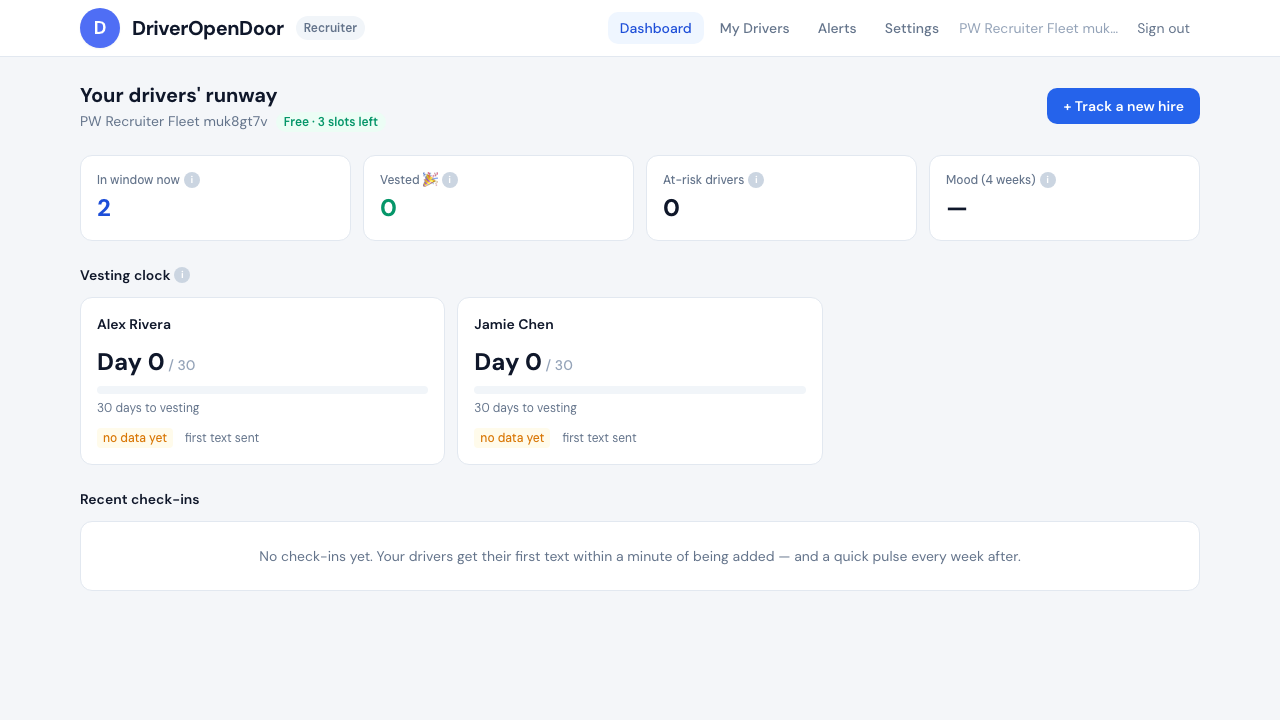
Day 22 of 30. Mood: trending negative. Eight days to vesting. That is a driver your recruiter can call this afternoon, not one they lose next week.
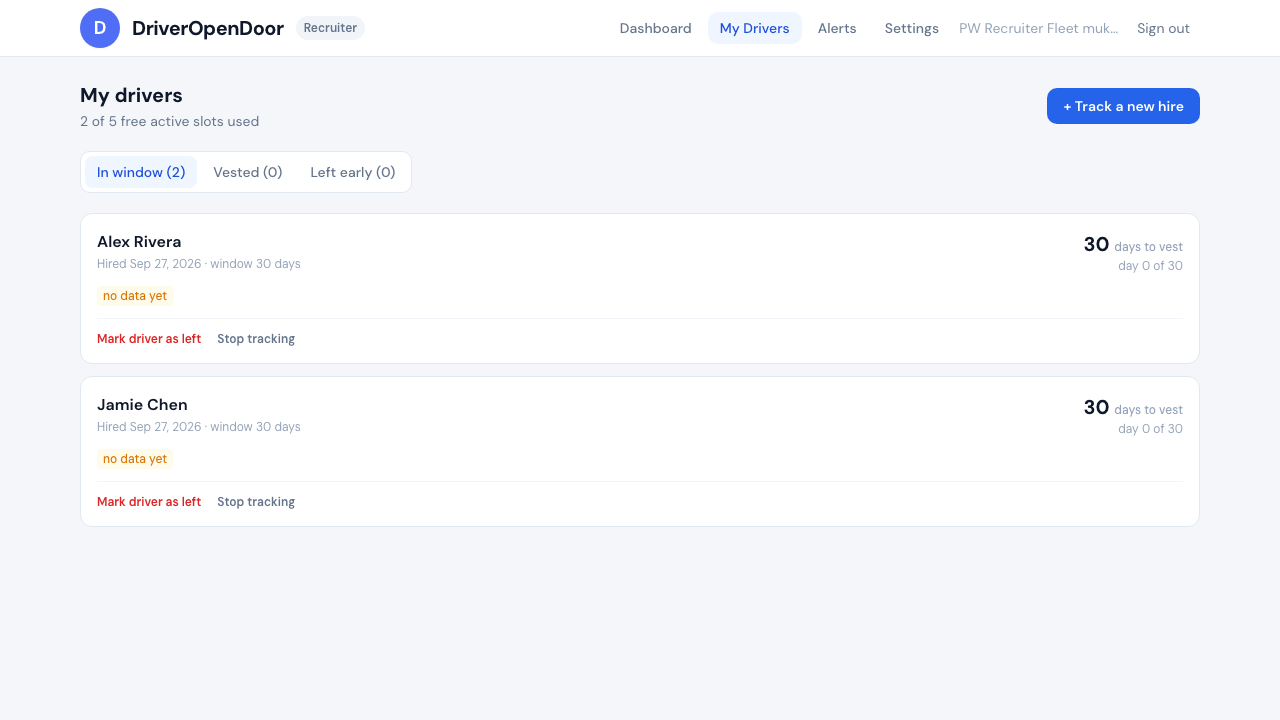
Every claimed driver shows up on the roster with its own countdown:
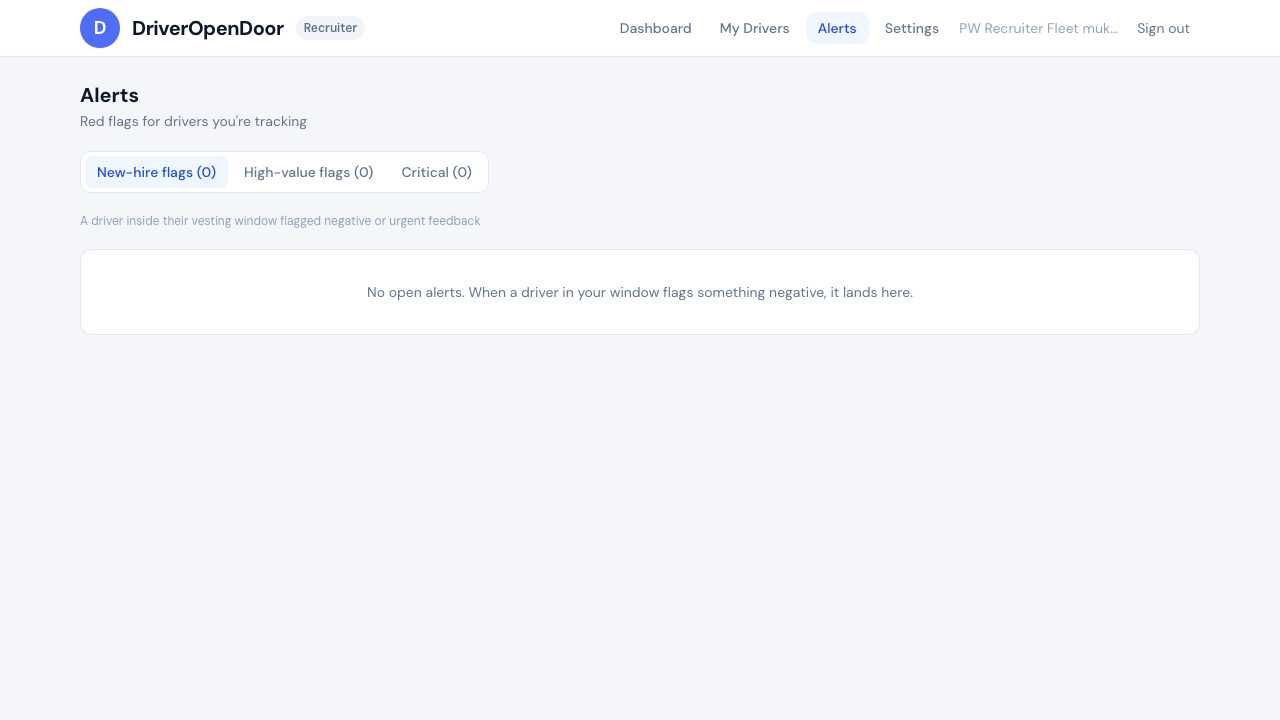
And when a new hire's check-in comes back negative or urgent, an alert lands with a plain-English "what to do" attached, because a heads-up without a next step is just stress:
Why this works when other tools don't
Most trucking recruiter bonuses pay out when a driver makes it past 30 days. That means the person with the strongest relationship to your newest, most fragile hires has a paycheck tied to exactly the outcome you care about.
Until now, that incentive had no information behind it. Recruiters were flying blind inside the one window their performance is measured on. The portal points their paycheck and your retention number in the same direction, then gives both of them data.
For the fleet, that means the money you already spend on recruiting finally comes with instrumentation: which hires stick, where new-driver problems actually come from, and an early-warning system pointed at your most fragile cohort, staffed by people who already know those drivers by name.
How much does it cost?
Two ways in, both fast:
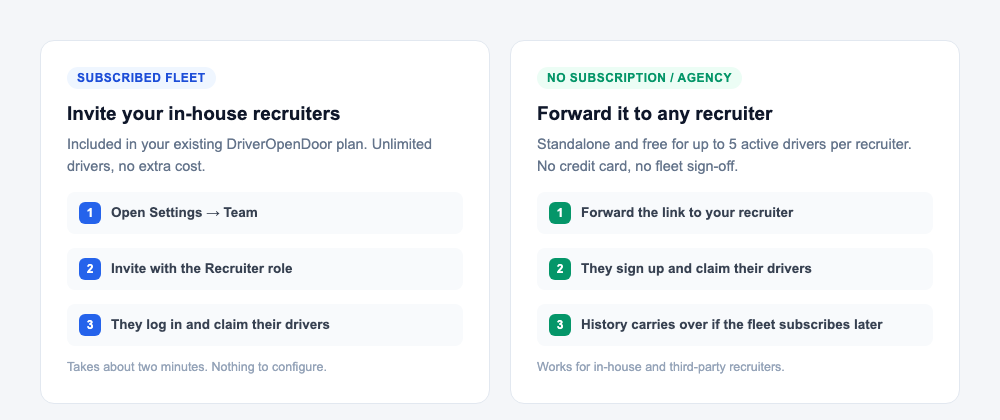
- Your fleet subscribes to DriverOpenDoor already: your in-house recruiters are included in your plan at no extra cost. Invite them from Settings, then Team, with the Recruiter role. Unlimited drivers, no cap.
- You do not subscribe, or you work with third-party recruiters: they can use it standalone, free, for up to 5 active drivers per recruiter. No credit card, no fleet sign-off. And if you adopt the full platform later, everything they tracked carries over.
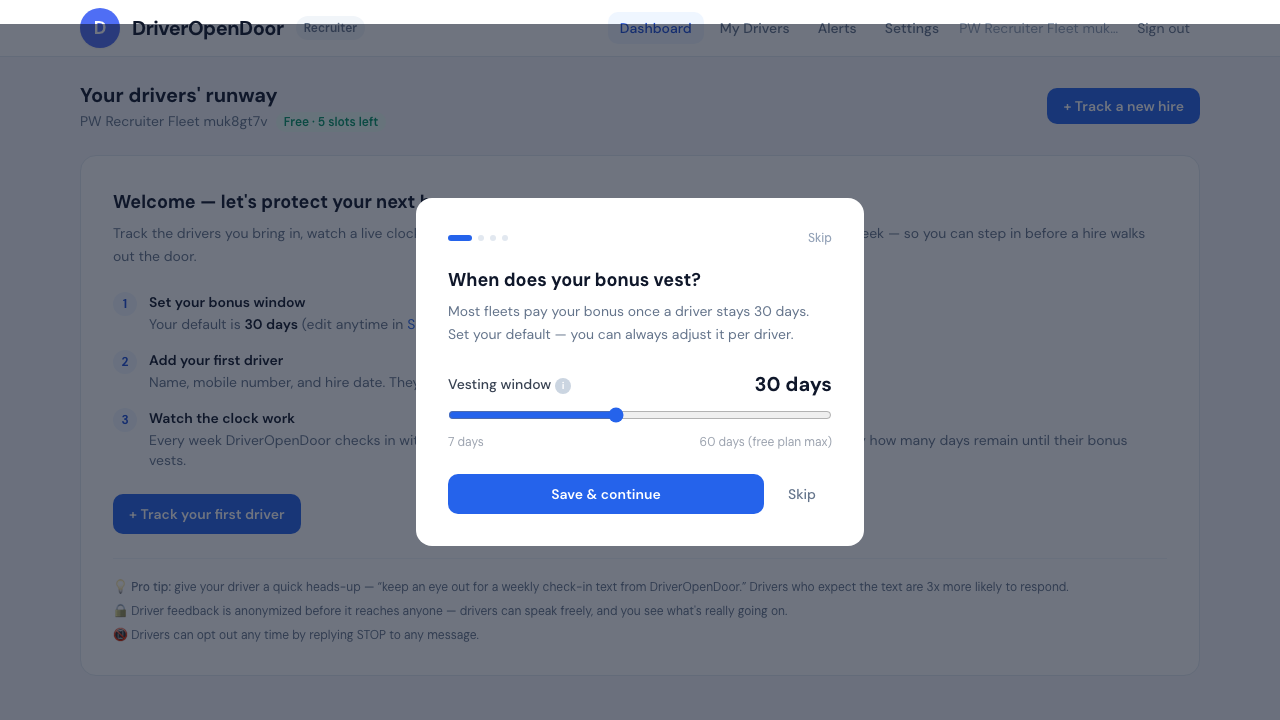
The first time a recruiter opens the portal, it walks them through setup. They set their bonus window, usually 30 days:
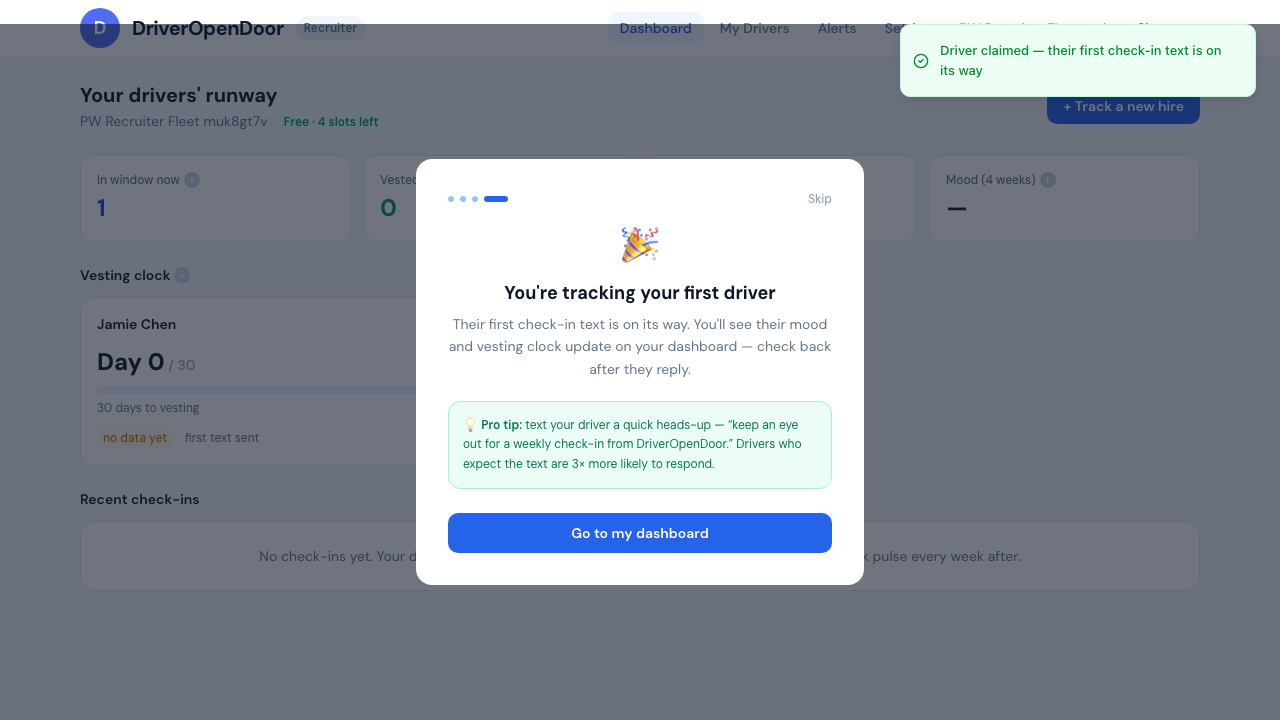
Then they claim their first driver, and the driver gets a friendly text within a minute. The clock starts that day.
Anonymous is why drivers answer
The check-ins never attach the driver's name to a complaint. Drivers answer honestly precisely because nobody, including the recruiter, sees who said what. The recruiter sees mood and patterns for their own claimed drivers, not identities attached to comments.
That honesty is the entire value. It is the difference between a real warning on day 12 and a polite "all good" right up until the resignation. If you want the full mechanics of how anonymous driver feedback works, we cover it in What Is Anonymous Driver Feedback?
Drivers can opt out at any time by replying STOP to any message.
The bottom line
You already spend real money filling seats. The first 30 days after you fill them is where that spend succeeds or fails, and it has been the one part of the pipeline nobody watches.
Now the people who placed those drivers are watching it. Free, in about two minutes.
See the full walkthrough at DriverOpenDoor for Recruiters, or if you are a recruiter, claim your first driver here.
FAQ
How much does it cost to recruit a truck driver?
Industry benchmarks put the cost of recruiting and onboarding a single truck driver between $5,000 and $12,000, with agency placements adding 15 to 25 percent of first year pay. A North Dakota State University study measured the average at $8,234 in 2019, and current estimates run higher.
What percentage of new truck drivers quit in the first 30 days?
One to two of every 10 new hires typically leave before the 30-day mark, and most drivers who quit a new fleet decide within their first month. Early-tenure churn is the most expensive kind, because the full recruiting and onboarding cost is lost with no productivity to show for it.
How do truck driver recruiter bonuses work?
Most trucking fleets pay recruiters a placement bonus when a driver they recruited stays past a threshold, typically 30 days but sometimes 60 or 90. The DriverOpenDoor recruiter portal gives recruiters visibility into exactly that window, so the person with the relationship can act before the threshold passes.
Is the DriverOpenDoor recruiter portal really free?
Yes. For recruiters at fleets without a DriverOpenDoor subscription, the portal is free for up to 5 active drivers, with no credit card. For fleets that subscribe, in-house recruiters are included in the plan with no driver cap.
Can drivers see that they are being tracked?
Drivers only see the same anonymous weekly check-in text the fleet platform already sends. They never see recruiter dashboards, their names are never attached to comments, and they can opt out at any time by replying STOP.
Start listening to your drivers this week.
Weekly anonymous SMS check-ins. AI analysis. Real-time alerts. Free 30-day trial.
Start free trial →